
Basement Flood Cleanup & Water Removal — Northern Illinois
Flooded basement? We’ve handled this call thousands of times across McHenry, Lake, Kane, DuPage, and northern Cook County. Powerful extraction, commercial drying, and full insurance documentation — from a locally owned company that has been working in these neighborhoods since 1987.
Why Basements Flood in Northern Illinois
Northern Illinois has specific conditions that make basement flooding more common than in other regions — heavy clay soils, older foundations, and aggressive weather swings. We know these patterns well.
Sump Pump Failure
The most common basement flooding call we get. Pump motor burns out, float switch sticks, power goes out — and a foot of water appears. If you don't have a battery backup sump pump, this is worth adding after we've dried you out.
Heavy Rain & Drain Overload
Northern Illinois clay soil doesn't absorb water well. During heavy rain events, the ground saturates quickly and water pushes through foundation cracks, window wells, and floor drains. This is especially common in older homes with block foundations.
Window Well Flooding
Improperly drained window wells fill during downpours and push water directly against basement windows. Window well covers help prevent this — but once it floods, extraction and drying are needed immediately.
Drain Tile Failure
Older homes in McHenry, Lake, and Kane counties often have aging clay drain tile around the foundation. When it fails or gets blocked, hydrostatic pressure pushes water through the floor and lower walls.
Lateral Sewer Backup
Heavy rain can overwhelm municipal sewer systems, causing sewage to back up through floor drains. This is a Category 3 biohazard situation requiring special handling. See our sewage backup cleanup page for details.
The Northern Illinois Clay Soil Problem
Most of McHenry, Lake, Kane, and DuPage counties sit on dense glacial clay — soil that absorbs water slowly and stays saturated for extended periods after heavy rain. This creates hydrostatic pressure against basement foundations that even well-built homes weren’t designed to handle indefinitely. During a wet spring or after a multi-day rain event, the ground simply can’t drain fast enough — and that pressure has to go somewhere.
Our Basement Flood Cleanup Process
From standing water to dry-certified and documented — here is exactly what happens when we arrive at a flooded basement.
Immediate Extraction
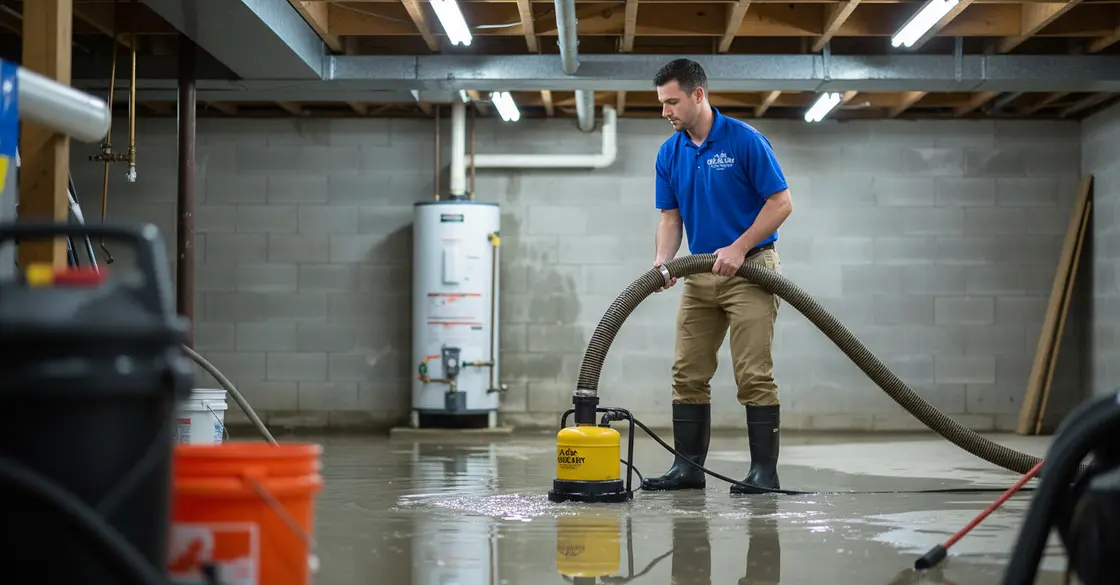
We pump and extract standing water as fast as possible. Powerful extraction handles high volumes quickly. For basement floods with several inches of water, we may use submersible pumps for bulk removal followed by powerful extraction for residual water.
Moisture Mapping
Standing water is just the visible problem. We use moisture meters and thermal imaging to map where water has migrated — into drywall, framing, stored items, and the concrete slab itself. This determines the full scope of drying needed.
Content Assessment
We assess stored items, furniture, and belongings in the affected area. Items that can be dried in place are documented. Items that need to be removed or replaced are noted in our damage assessment — which you'll need for your insurance claim.
Structural Drying Setup
Commercial dehumidifiers and high-velocity air movers are placed throughout the basement. Equipment placement is based on our moisture map — not just pointed at the obvious wet spots. We monitor daily and adjust as readings change.
Mold Prevention Treatment
Once extraction is complete, affected surfaces receive antimicrobial treatment. Basements are prone to mold because they're already humid environments. Fast drying and treatment are the best prevention — we typically complete this within the first 24 hours.
Documentation & Closeout
We take final moisture readings, document the completed work with photos and drying logs, and walk through the results with you. All documentation is provided in the format your insurance adjuster needs.
Basement Flooding — FAQ
What homeowners most often ask after a basement floods.
Does homeowner's insurance cover basement flooding?
It depends on the cause. Sudden and accidental events — like a sump pump failure or a burst pipe — are typically covered by standard homeowner's policies. Gradual seepage over time is usually not covered. Flooding from outside (rising ground water, overland flow) requires separate flood insurance through NFIP or a private carrier. Sewer backup coverage is often an endorsement you can add. We document the cause and extent of damage to support your claim — but coverage questions are best directed to your agent.
My sump pump failed. How do I prevent this again?
The most practical upgrade is a battery backup sump pump. These activate automatically when the primary pump loses power and can handle most rain events on battery alone. Some homeowners also add a water-powered backup as a secondary failsafe. We don't sell or install sump pumps, but we're happy to point you toward reputable plumbers and waterproofing companies in the area after we've addressed the immediate water damage.
How long does basement flood cleanup take?
Water extraction typically takes 2–6 hours depending on volume. Structural drying — getting the concrete slab, walls, and any framing back to target moisture levels — usually takes 3–5 days with commercial equipment running continuously. We check readings daily. A basement with finished walls or stored items may take longer. We don't remove equipment until moisture readings confirm everything is genuinely dry.
Can I do anything before you arrive to help?
If it's safe to enter: relocate valuables and electronics to dry areas, move furniture legs off wet carpet or concrete, and document the damage with your phone for insurance purposes. If water is still entering, identify and stop the source if possible — shut the main sump discharge line, seal the window well temporarily with plastic, or address whatever is still flowing. Do not run household fans as a substitute for commercial drying equipment — they move surface moisture but do not control humidity.
Is a wet basement always a mold risk?
Yes, but the risk is manageable with fast response. Mold requires moisture, organic material, and time. A concrete slab alone is not a great mold host — but drywall, wood framing, carpet, and stored cardboard are. The critical window is 24–48 hours. A basement that gets dried out within that window has a much lower mold risk than one that sits wet for several days. That's why calling immediately matters.