
What to Do When Your Dog Has an Accident in the House
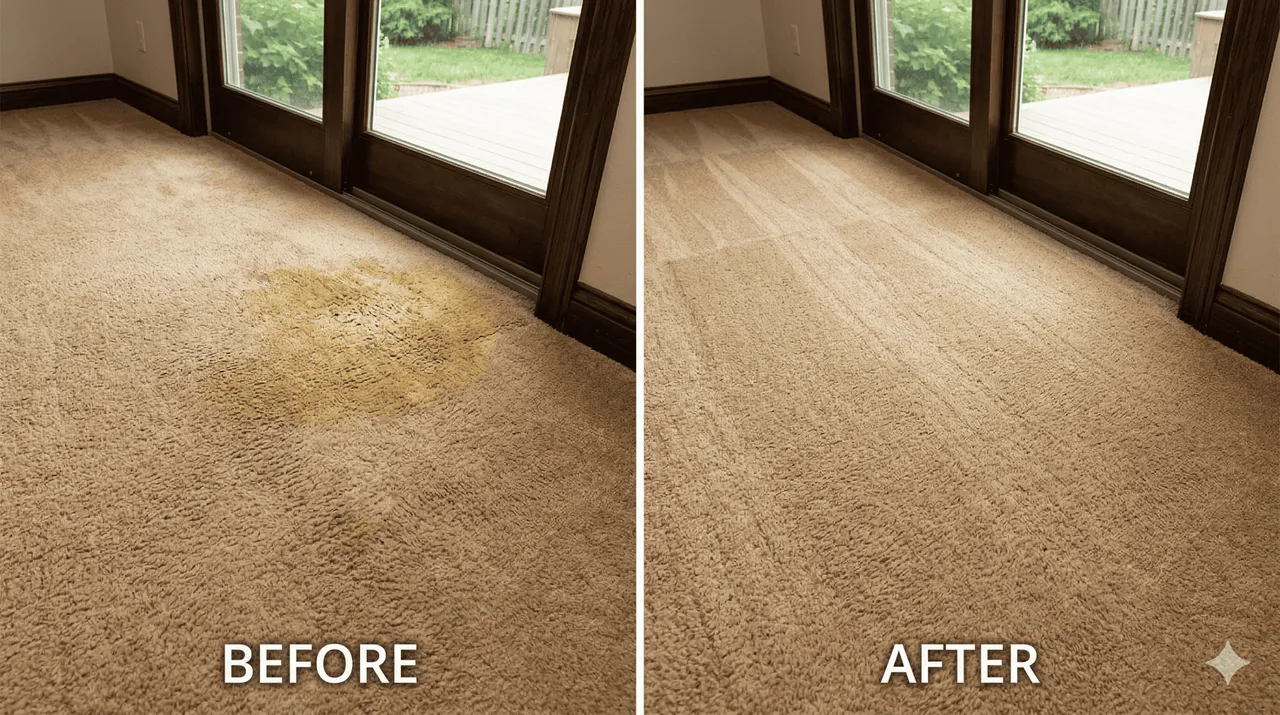
Every dog owner has lived this moment. You round the corner and there it is on the carpet, your dog avoiding eye contact a few feet away. Take a breath, because the worst thing you can do right now is nothing, and the second worst is to panic and scrub. What happens in the next few minutes genuinely decides whether this becomes a forgotten footnote or a stubborn spot you smell every humid day for the next year. The good news: with the right quick response, most fresh accidents clean up completely. Here is exactly what to do, in order, and how to tell when it is time to call in help.
Why the First Few Minutes Matter
Dog urine does not just sit politely on the surface of your carpet. It spreads outward and downward, wicking into the backing, the cushioning pad underneath, and sometimes the subfloor below that. The longer it sits, the deeper it travels and the more it dries into the fibers. Fresh urine is mostly liquid and reachable. Dried urine is a different problem entirely, because as it dries it leaves behind uric acid crystals that bond tightly to whatever they touch and are not soluble in plain water. That is the difference between a five-minute cleanup and a lingering odor. Speed is your single biggest advantage, so move quickly but calmly.
The Immediate Response, Step by Step
Follow these steps in order. Resist the urge to skip ahead to the spray bottle before you have done the unglamorous part, which is getting the liquid out.
- Blot, do not rub. Lay a thick stack of paper towels or a clean white cloth over the spot and press down firmly. Stand on it if you need the weight. Rubbing or scrubbing only grinds the urine deeper into the fibers and frays the carpet pile. Your goal is to lift liquid up and out, so keep swapping in dry towels until they come away nearly dry.
- Rinse with cool water, then blot again. Pour a small amount of cool (never hot) water over the area to dilute what remains, then blot it all back up the same way. Hot water can set the proteins in urine, much like it cooks an egg, so keep it cool. Repeat this rinse-and-blot once or twice.
- Apply a pet-specific enzyme cleaner. This is the step that actually removes the odor rather than masking it. Enzyme cleaners contain proteins that break uric acid and other urine compounds down into simple, odorless substances. Saturate the spot generously, enough that the cleaner can reach as far down as the urine did, and let it dwell for the time the label specifies. Do not blot it dry too soon. The enzymes need time and moisture to do their work.
- Let it dry, then check by smell. Allow the area to air-dry fully. Once dry, get down close and smell it, ideally on a warm or humid day. Humidity reactivates any leftover odor, so if it still smells faintly of urine, treatment did not reach all of it and you should repeat or escalate.
Why You Should Never Use Ammonia
This one trips up a lot of well-meaning owners. Ammonia and ammonia-based household cleaners seem like a logical choice, but they are exactly the wrong tool for dog urine. Ammonia is a component of urine, so to your dog's nose, an ammonia-cleaned spot smells like a fresh place to go. Instead of erasing the scent marker, you have reinforced it, practically inviting your dog back to re-mark the same spot. Ammonia can also bond with urine proteins and help set the stain. Stick with a true enzyme cleaner, and skip vinegar as a standalone fix too. Vinegar can knock down odor temporarily, but it does not break down the uric acid crystals the way enzymes do.
Why Urine Soaks Past the Surface
Here is the part that explains so many "I cleaned it but it still smells" stories. A spray bottle wets the top of the carpet, but the urine often went much deeper. Carpet sits over a porous pad, and that pad acts like a sponge, drawing the liquid down and spreading it wider than the visible spot. From there it can reach the subfloor. If you only treat what you can see, you leave most of the contamination untouched, and on the next humid day the smell rises right back up through the fibers. A surface clean simply cannot reach where the problem actually lives.
Puppies Versus Older Dogs
Not all accidents are the same, and the cause shapes your response as much as the cleanup does.
- Puppies and potty training. Frequent small accidents during house-training are normal and temporary. The key here is thorough enzyme cleanup, because any lingering scent becomes a homing beacon that tells the puppy "this is the bathroom." Removing the odor completely is half of training.
- Older and senior dogs. A house-trained adult dog that suddenly starts having accidents is telling you something. Larger volumes, more frequent puddles, or a dog that seems unaware it happened can point to a urinary tract infection, kidney issues, or age-related changes worth a conversation with your vet. Clean the spot, but also pay attention to the pattern.
DIY or Call a Professional?
A fresh, single, small accident on the surface is well within DIY range using the steps above. But some situations are stacked against a spray bottle and a roll of paper towels. Consider calling a professional when you notice any of the following:
- Set-in odor that comes back after you have already cleaned, especially on humid days.
- Repeat spots, where your dog keeps returning to the same area, a sign the scent marker was never fully removed.
- Large volume or multiple accidents, the kind that clearly soaked well beyond the surface.
- Suspected pad or subfloor saturation, where the stain is wide, the carpet still feels damp underneath, or the smell is strong and persistent.
These are the cases where the urine has gone where your tools cannot, and more home cleaning just pushes water around the top of the problem.
How Professional Pet Urine Removal Actually Works
A professional treatment is built specifically to reach the layers you cannot. The process generally looks like this:
- UV detection. A black light makes dried urine glow, revealing the true size of each spot, including old accidents you never knew were there. You cannot treat what you cannot find.
- Enzyme treatment. A professional-strength enzyme application breaks the uric acid crystals apart at their source, eliminating odor rather than covering it.
- Sub-surface extraction. Specialized equipment flushes and pulls contamination out of the carpet backing, the pad, and down to the subfloor, the area a household cleaner simply cannot touch.
- A guarantee on the result. The standard a homeowner should expect is simple: the smell is gone, or you do not pay.
At A OK Quick-Dry, our Pet Urine Treatment uses exactly this approach, with a free UV inspection up front and a 100% odor-removal guarantee. Our cleaning process is plant-derived and non-toxic, so it is safe for the kids and pets who share that floor, and carpets are usually dry in about one to two hours.
Accidents happen, and a single spot does not have to mean living with the smell. Handle the fresh ones quickly with the steps above, and when an odor digs in deeper than a towel can reach, the family team at A OK Quick-Dry has been helping homes across Crystal Lake, Algonquin, Huntley, and the rest of the northwest Chicago suburbs since 1987. Learn more about our pet urine removal service, and breathe easy in your own home again.
More Carpet Cleaning Tips
- Pet Urine & OdorDoes Professional Carpet Cleaning Get Rid of Dog Urine?Yes — but only when the visit includes a real pet urine treatment. Here's why a standard cleaning can't kill the odor, where dog urine actually goes, and the deep-treatment process that removes it for good.Read article →
 Pet Urine & OdorWill Carpet Cleaning Get Rid of Cat Urine?Regular cleaning makes the spot look better for a few days — then the smell comes back. Here's the chemistry behind why, and the process that actually eliminates cat urine for good.Read article →
 Pet Urine & Odor7 Facts About Pet Urine in Your Carpet (You Need to Know)Seven things every pet owner should know about how urine damages carpet — and what it really takes to remove the odor at the source.Read article →